Arts & Crafts Wallpaper for Modern Homes
Stacie HumpherysYour client wants a home that feels like a refuge, not a showroom. A trend piece will feel dated in three years, and they don't want that either. They want to walk in at the end of a hard day and feel their shoulders drop the moment the door closes because the room relaxes them.
Arts and crafts wallpaper does that better than almost any other single design choice, and understanding why will make you a more confident advocate for it with clients who think it sounds old-fashioned.
This post covers what makes the style genuinely timeless, why it creates a specific feeling of calm and shelter in modern spaces, and how to use it well.
Jump to:
Why arts and crafts wallpaper never goes out of style
The design principles at work
The feeling it creates: koselig and nature-derived design
How to use it in a modern home
Common questions
The collections
Why Arts and Crafts Wallpaper Never Goes Out of Style
Most design trends date themselves because they are responding to a cultural moment. Arts and crafts wallpaper has been on walls for over 150 years because it is responding to something older and more persistent: the way human beings perceive the natural world, and the specific relief that perception offers against the noise and pace of the modern one. The industrial world we live in today is relentless. The natural world is not. Arts and crafts wallpaper carries that quality indoors, which is why it has never needed updating.
The design principles that make these patterns work are the same principles that make a landscape beautiful. Your clients already respond to them. They just may not know why.

Above: William Morris, Strawberry Thief, 1883. Every motif came from direct observation of nature. (Photo: Wikimedia Commons)
The Design Principles at Work
Contrast
Stand in an open field in late afternoon when a thunderstorm is building to the west. The sky in front of you is purple-blue. The grass behind you is gold. Your eye cannot look away.
![Golden wheatgrass against a dark storm sky -- complementary colors in nature demonstrating the design principle of contrast that arts and crafts wallpaper uses to make botanical motifs glow from the wall. Photo: [Photographer Name], Unsplash](https://cdn.shopify.com/s/files/1/0760/1697/6091/files/tasha-lyn-KQBE5nFh30k-unsplash_1.jpg?v=1776026088)
That is not an accident. Purple-blue and gold sit directly opposite each other on the color wheel. Complementary colors create maximum contrast, and maximum contrast is what makes the eye stop and pay attention. You do not need to know color theory for it to work on you. It works anyway.
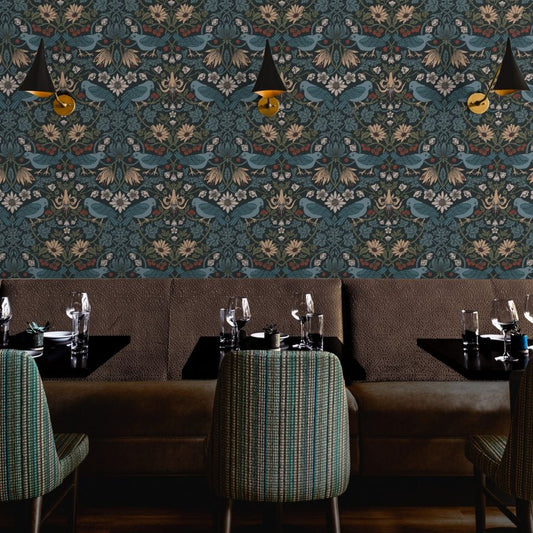
Arts and crafts patterns use contrast the same way. The Timberline Dark colorway in the Wildcraft collection places warm botanical forms against a near-black background. The motifs seem to glow from the wall.

That is the same optical principle as the storm and the field -- dark behind, light in front -- and it creates the same involuntary pause. Your client will feel it before they can name it.

Morris understood this instinctively. His Acanthus wallpaper from 1875 uses the same principle -- jewel-toned botanical forms set against a deep ground, the warmth of the motifs intensified by the darkness behind them. It is one of the reasons his work has stayed on walls for 150 years.
The takeaway for interiors: Dark colorways make a room feel intimate and grounded. A deep botanical on a single accent wall gives the rest of the room something to rest against -- the way the gold field needs the dark sky to come alive.
Scale and Proportion
Anyone who has stood in open country and looked out at fifty miles of uninterrupted landscape understands scale at a bodily level. The vastness is not threatening. It is clarifying. You feel small, and somehow that is a relief.
![A vast open Montana landscape under a wide sky -- the experience of scale and proportion in nature that arts and crafts wallpaper recreates in an interior through bold pattern repeats. Photo: [Photographer Name], Unsplash](https://cdn.shopify.com/s/files/1/0760/1697/6091/files/steven-cordes-De64i3ZHrY8-unsplash_1.jpg?v=1776026733)

Arts and crafts wallpaper plays with scale in ways that create a similar feeling in a room. A large pattern repeat in a small space does not overwhelm it -- it gives the room depth and weight, the sense of being held inside something larger than itself. This is why arts and crafts wallpaper works so well in powder rooms and small studies, spaces where you want intensity rather than the illusion of openness.
The takeaway for interiors: Scale up in small rooms where the goal is intimacy and drama. Scale down in larger rooms where you want the pattern to read as texture from a distance. Trust larger repeats more than you think you should.
Rhythm, Pattern, and Harmony
A healthy forest has rhythm. A stand of ponderosa pines, spaced by light and competition, repeats across a hillside in a way that feels ordered without being rigid. Your eye moves through it without effort. You do not have to work to understand it.
This is what a well-designed pattern repeat does in a room. The eye finds the rhythm, learns it, and relaxes. There is neurological research behind this: the brain conserves energy when it can predict what comes next. Pattern gives the brain permission to stop scanning for what is wrong and simply rest.


If rhythm is the beat, harmony is how all the parts sound together. A healthy ecosystem does not just repeat -- it connects. Root systems communicate underground. Vines thread through the canopy. Birds carry seeds from the plants that feed them. Nothing exists in isolation, and the beauty of a living landscape is partly the beauty of that interdependence, even when you cannot see all of it at once.
Arts and crafts patterns reflect this, and it is one of the things that makes them feel so alive on a wall. Look closely at a Morris design, or at the trailing florals and vines in the Wildcraft Collection, and you will see that the motifs are not arranged side by side like specimens in a catalog. They are threaded through each other. A vine connects a bird to a flower to a leaf. The repeat does not just tile across the wall -- it breathes. The eye follows the connections the way it follows a path through undergrowth: curious, unhurried, finding its way naturally from one element to the next.
![Trailing vines threading through a forest -- the interconnection of a living ecosystem that arts and crafts pattern design reflects in its threaded botanical motifs. Photo: [Photographer Name], Unsplash](https://cdn.shopify.com/s/files/1/0760/1697/6091/files/ivanna-vinnicsuk-AFoMGRLV7C4-unsplash_1_430x.jpg?v=1776027832)

That quality -- interconnection, the sense that everything in the pattern belongs to the same living system -- is one of the reasons arts and crafts wallpaper makes a room feel settled and whole rather than simply decorated.
The takeaway for interiors: In any space where the goal is calm -- a bedroom, a reading room, a home office where the botanical on the wall is the one thing in the room that is not a screen -- a trailing botanical at a medium scale can do more for how a room feels than almost any other single choice.
Unity
A balanced ecosystem has nothing in it that does not belong. Every species earns its place. Nothing is decorative for its own sake. The result is a coherence that reads as beauty even when you cannot name all its parts.
![A Rocky Mountain alpine meadow with diverse wildflowers -- a balanced ecosystem where every species earns its place, mirroring the design principle of unity in arts and crafts wallpaper. Photo: [Photographer Name], Unsplash](https://cdn.shopify.com/s/files/1/0760/1697/6091/files/courtney-kenady-h5ZPU1hU5CM-unsplash_1_430x.jpg?v=1776028448)

Arts and crafts design operates on the same principle. Every motif in a Morris pattern (or in a Pine + Feather collection) comes from direct observation of a real plant, a real bird, a real place. Nothing is invented for decoration alone. The result is a unity that rooms built around trend pieces rarely achieve, because trends assemble things together. Nature-derived design coheres.
The takeaway for interiors: Arts and crafts wallpaper is one of the easier patterns to build a full room around because it already contains a complete palette. Pull one color from the wallpaper for upholstery. Use another for trim. The palette is already unified because it came from nature, which is always internally consistent.
"The design principles that make arts and crafts patterns work are the same ones that make a landscape beautiful. Your clients already respond to them. They just may not know why."
The Feeling It Creates: Koselig and the Case for Nature-Derived Design
There is a Norwegian concept called koselig (pronounced koo-sheh-lee). It translates loosely as cozy, but that word does not do it justice.
Koselig is a specific feeling -- of shelter, ease, and warmth -- that comes from being in a space where everything in it seems to be on your side. Candlelight. Wood and natural stone. The sense that the room itself is unhurried, and that you can be too.

Above: A koselig interior is softened by arts & crafts style wallpaper. (Photo: homeg.org)
Most of your clients cannot slow down their lives. But you can give them a room that creates the feeling of slowness even on a Wednesday in November when everything is relentless. That is what good interior design does at its best: it does not change how much time your client has, it changes how they feel while they are using it.
Arts and crafts wallpaper creates koselig because it is built from the same raw materials: natural forms, warm palettes, organic rhythm, the unmistakable evidence of a human hand in the making. It does not demand attention. It earns presence. A room with a strong botanical on the walls and honest materials everywhere else will make people feel something they may not be able to articulate -- but will absolutely notice, and remember.
The Scandinavians understood this long before it became a design conversation. Norwegian rosemaling -- the tradition of painting swirling botanical motifs onto furniture, walls, and everyday household objects -- has been creating this feeling since the mid-1700s, in the Telemark and Hallingdal regions and on the log walls of medieval stave churches. Beautiful things made by hand from natural forms, placed in the spaces where people lived and worked and gathered. The Arts and Crafts movement, when William Morris launched it in the 1880s, was in many ways trying to recover what folk traditions like rosemaling had never lost.

Above: Rosemaling on the interior walls of the Uvdal Stave Church, Numedal, Norway. Botanical forms painted onto the surfaces of everyday and sacred spaces, centuries before the Arts and Crafts movement was named. Photo: Frode Inge Helland, CC BY-SA 3.0

Above: Norwegian rosemaling plate in the Telemark style. The swirling botanical forms, interconnected motifs, and dark backgrounds read as remarkably contemporary. Photo: Rune Nesher, CC BY-SA 4.0

Above: William Morris, Willow Bough. The river was visible from his study window. (Wikimedia Commons / The Metropolitan Museum of Art.
Morris named his patterns after the specific places and creatures that inspired them. Willow Bough came from the river outside his study window. Strawberry Thief came from the birds raiding his garden. The specificity was intentional: a pattern rooted in a real place carries that rootedness into every room it enters. Your client does not need to know the source. They feel it anyway.
How to Use Arts and Crafts Wallpaper in a Modern Home
The question designers ask most often: how do I use this style without making a room feel like a period room?
The answer is mostly in the colorway and what you pair it with. The motifs are traditional. The application does not have to be.
Choose the colorway based on the room's emotional job
Dark colorways -- near-black backgrounds, deep forest greens, inky blues -- read as contemporary and work well in spaces meant to feel intimate and enveloping: a primary bedroom, a library, a dining room, a moody powder room. The Timberline Dark colorway in the Wildcraft collection is a good example. It reads as sophisticated and current, not historical.

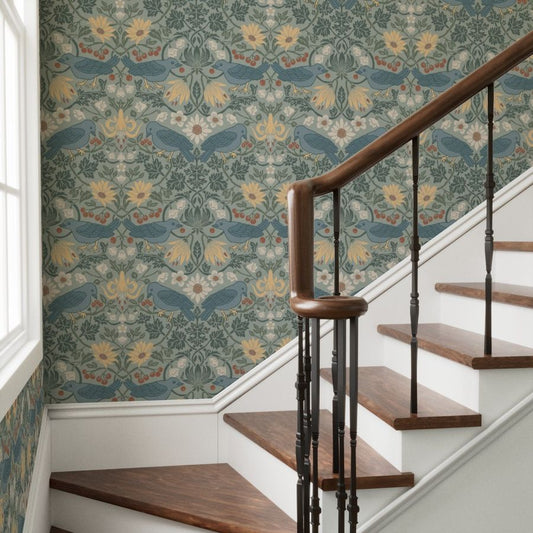
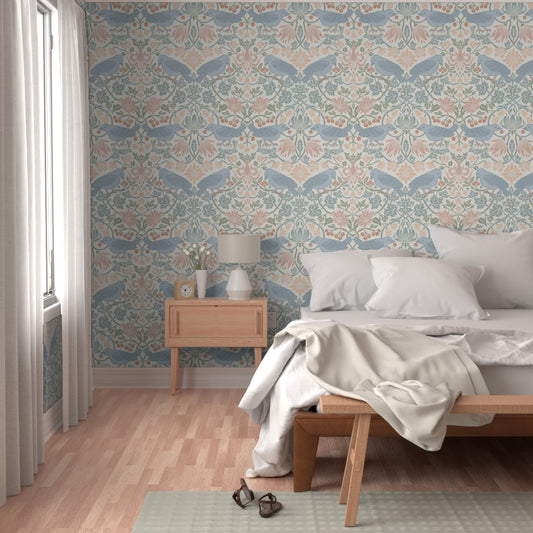
Lighter colorways work in rooms where you want the pattern to function more as texture rather than statement. Glacier Sage and First Light from the Wildcraft Collection are good examples -- the botanical forms read clearly up close but settle into a soft, restful field from across the room. A bedroom, a bathroom, a hallway where the goal is quiet welcome.

Pair with natural materials
Arts and crafts wallpaper belongs next to wood, stone, linen, leather, and aged brass. Chrome and high-gloss lacquer fight it. The material language should match the design language: honest, tactile, made from something real.
A room with arts and crafts wallpaper, wide-plank wood floors, and simple linen upholstery will feel complete. The same wallpaper in a room full of acrylic and chrome will make the client feel vaguely uncomfortable in a way they may not be able to name -- but will feel every time they walk in.
Let the wallpaper do the work
In a room anchored by a strong botanical pattern, you do not need much else competing for attention. Simple furniture, good light, a few objects that mean something. The wallpaper is already doing the emotional work. Trust it.
Think small
Some of the most memorable wallpaper moments happen in small rooms. A powder room that makes guests stop. A mudroom that makes your client exhale when they come in from a hard day. A home office where the botanical on the wall is the one soft, living thing in a room full of hard edges and screens.
Your client does not always need the whole house. Sometimes they need one room that gives them the koselig feeling. That room will become their favorite in the house, and they will tell people about it.
If you are working on a project and want to talk through which collection or colorway might be the right fit, I am always glad to have that conversation. Reach out here.
Common Questions
Whether you are specifying for a project or making decisions for your own home, these come up often.
Does arts and crafts wallpaper work with contemporary furniture?
Consistently, yes. The key is the colorway. A dark botanical next to a clean-lined modern sofa creates a tension that reads as intentional and interesting rather than mismatched. Think of it the way you would think about a vintage textile on a modern chair -- the contrast is the point, and it works because both things are well made.
Is it too traditional for a client who wants a current look?
The style is old. The feeling it creates is not dated. If a client says they want a space that feels grounded, organic, warm, and not trend-dependent, they are describing arts and crafts wallpaper whether they know it or not. The conversation is usually about helping them see past the historical association to the sensory experience underneath it.
What rooms work best?
Any room where the goal is for the occupant to slow down: bedrooms, dining rooms, studies, powder rooms, bathrooms, mudrooms. It is less successful in spaces designed to feel energetic and forward-moving -- a very contemporary open-plan kitchen, a home gym, a children's play space.
Can it work in a hospitality or commercial setting?
Yes. Arts and crafts wallpaper in a hotel room, a boutique office, a spa, or a restaurant signals quality, craft, and longevity. It tells the people in the space that someone cared about how they would feel. All Pine + Feather collections are available in commercial vinyl for hospitality and contract applications. See custom and hospitality work here.
Will it photograph well?
Exceptionally. The depth and detail in botanical patterns rewards both wide room shots and close editorial photography. Dark colorways in particular read beautifully in low light, which is why they appear consistently in shelter magazine interiors.
How do I know how much wallpaper I need?
Use the Pine + Feather wallpaper calculator for an accurate estimate, or reach out and I am happy to help you calculate for a specific project.
The Collections
All Pine + Feather Studio wallpaper is drawn from direct observation of the Rocky Mountain West -- a landscape where the design principles described above are on full display in every direction. The botanical motifs are specific rather than generic, and the palettes come from real places rather than trend forecasts.
The Wildcraft Collection
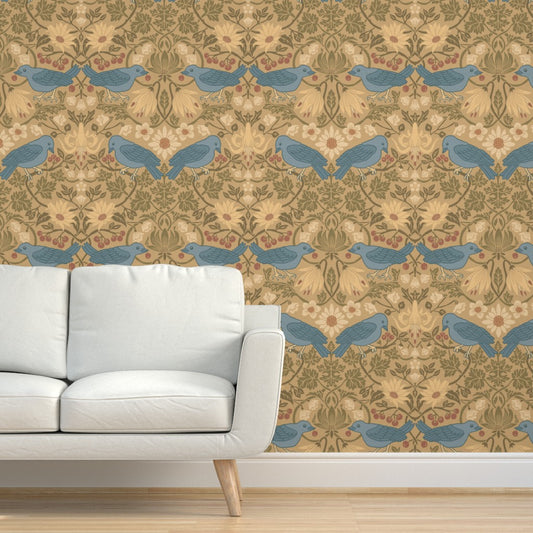
Arts and crafts structure, Rocky Mountain species. The Wildcraft Collection is built around the Huckleberry Thief pattern -- a direct conversation with William Morris. Where his Strawberry Thief came from a British garden, this one comes from a huckleberry patch at 7,000 feet in the Montana Rockies. The pattern is available in four colorways, each designed for a different room and a different feeling.
Available in traditional, pre-pasted, peel and stick, and commercial vinyl. Custom colorways and custom scale available for the right projects.


A Last Thought
The Arts and Crafts movement was an argument that beauty is not a luxury. That a well-made, nature-derived object in a room changes how the people in that room feel -- not because it is impressive, but because it connects them to something slower and older than their day.
Your clients are busy. They may not be able to change that. But you can give them a room that tells them, the moment the door closes, that it is safe to stop.
That is what good wallpaper does. That is what arts and crafts wallpaper has always done.