Vintage Bird Wallpaper: A Field Guide
Stacie HumpherysIf you happen to have the Merlin app on your phone, you know it has nothing to do with the mythical wizard prominently featured in the legend of King Arthur.
No, you have this app because you know the feeling. You hear a bird song outside, hold up your phone, and thirty seconds later you have a name and a photograph for a bird you have walked past a hundred times without really seeing.
Jump to:
A Brief and Nerdy History | What to Look For | A Love Letter to Home | Choosing Your Colorway | Bring It Home
The beautiful bubbling flute-song of the Western Meadowlark.
I have been studying and painting these birds for years -- and I am still not over the Steller's Jay, doing its thing in a pine tree with its scolding shaack-shaack-shaack.

The repetitive, metronomic toot -- toot -- toot -- toot (repeated endlessly at the same pitch and tempo, sometimes for hours, in the dark, from a tree you cannot locate, like a truck backing up) -- the Northern Saw-whet Owl. Not that I have, ahem, personal experience with this.
Adding a new species to the life list is a small and disproportionate thrill, and once you start doing it, you start paying a different kind of attention to the world outside.
Birders are trained to stop and really look. That quality of attention -- unhurried, curious, rewarded by detail -- is exactly what good vintage bird wallpaper asks of the people in a room. It is not a coincidence that birds have been on walls for three centuries and show no signs of leaving. They earn the look every time.

A Brief and Nerdy History of Birds on Walls
The story starts in the early 1700s, when European aristocrats developed an obsession with Chinese hand-painted wallpaper panels. These panels were painted on silk or mulberry paper, featuring exotic birds among flowering branches and bamboo. They were extraordinarily expensive and deeply coveted.

The birds were often fantastical or at least unfamiliar: pheasants, cranes, and species that existed in the European imagination more than in any field guide. They were beautiful precisely because they were foreign and strange.
This chinoiserie tradition established something important: birds belong on walls. By the time it fell out of fashion in the early 1800s, the idea was embedded in Western interior design deeply enough that it never fully left.
Then came Audubon.
John James Audubon's Birds of America, published between 1827 and 1838, is one of the most extraordinary objects in the history of natural history illustration. The prints are life-size: a Trumpeter Swan takes up an entire double-elephant folio page (that's 39.5 inches tall by 28.5 inches wide).

They were painted from specimens Audubon shot himself, posing the dead birds with wires to capture them mid-motion. It is a slightly alarming method by modern standards, but the results were unlike anything anyone had seen: birds rendered with scientific accuracy and genuine artistic drama simultaneously.
The prints became cultural objects far beyond ornithology.An original set sold at Sotheby's in 2010 for over eleven million dollars.
Audubon changed how people looked at birds. After him, accuracy mattered. The stylized, vaguely-plausible birds of chinoiserie gave way to something more specific and more demanding: illustration that required the artist to actually know what they were drawing.
The Victorian era ran with this. Post-Darwin, natural history became a popular obsession rather than a scholarly niche, and birds became a fashionable subject for decorative design precisely because they were being taken seriously as scientific subjects.

Bird watching emerged as a hobby. Natural history illustration informed wallpaper, textile, and ceramic design directly. Birds were everywhere in the Victorian interior, and they were increasingly recognizable species rather than decorative symbols.
The Arts and Crafts movement, in the 1880s and beyond, did something slightly different: it stylized the observed bird back into pattern. William Morris's thrushes in Strawberry Thief are clearly thrushes -- you would not mistake them for anything else -- but they are also motifs, flattened and repeated across a surface in a way that chinoiserie's exotic birds never were.


This is the direct visual ancestor of what we call vintage bird wallpaper today: nature-derived, species-specific, rendered with a visible human hand, and designed to work as pattern across a wall.
Three hundred years of birds on walls, each generation adding a new layer to the tradition. When you choose vintage bird wallpaper for a room, you are buying into all of it.
What to Look For
Not all vintage bird wallpaper is working in this tradition with the same level of intention. A few things consistently separate patterns that feel genuinely right from ones that feel like decoration for decoration's sake.
Specificity. My favorite vintage bird wallpaper draws real species from real places. A mountain bluebird on a syringa branch is more interesting than a generic songbird on a generic branch -- not because the bluebird is prettier, but because someone had to know what they were drawing. That knowledge comes through in the finished pattern, and the people who notice it will notice it strongly. Look for illustrations where you can actually identify the species. It also gives a sense of place.
The hand. Drawn from observation is different from assembled from reference. A pattern built by someone who has actually watched birds looks different from one built by someone who searched stock images. The variation is subtle but it reads in a room. Hand illustration carries the slight imprecision of something that was made, and that quality is what gives a wall warmth rather than the flatness of a print.
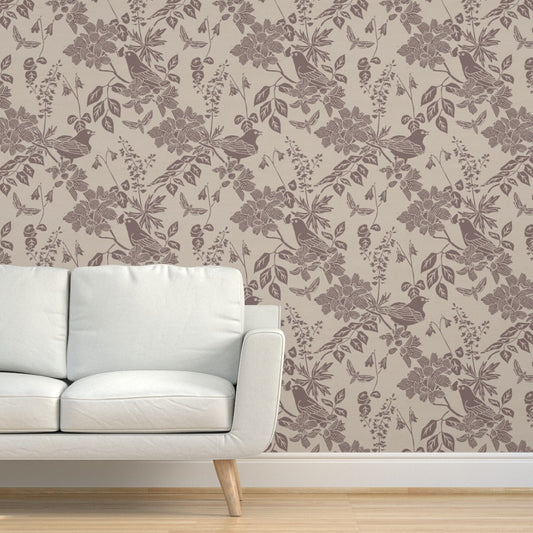
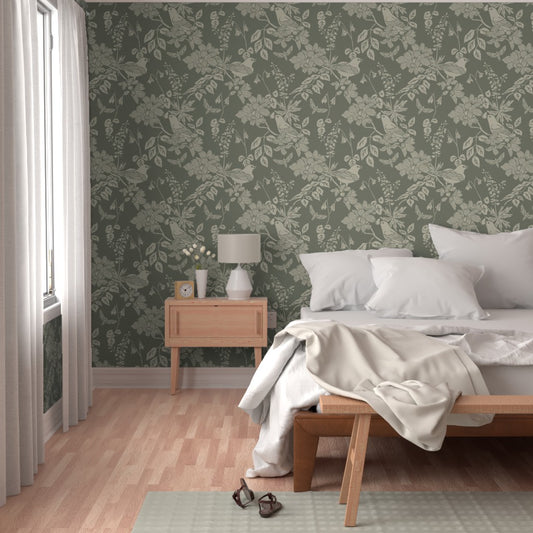
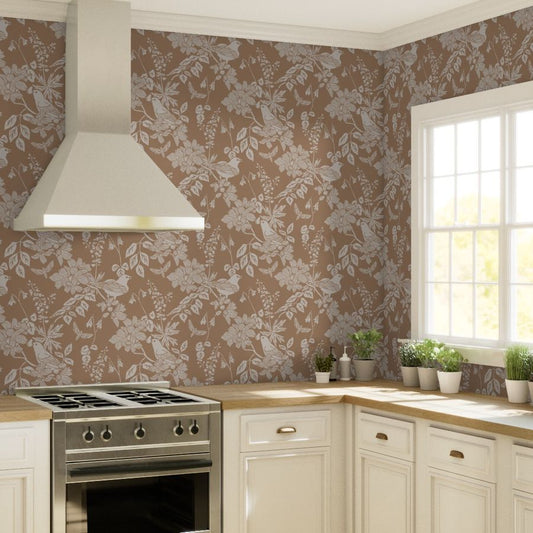
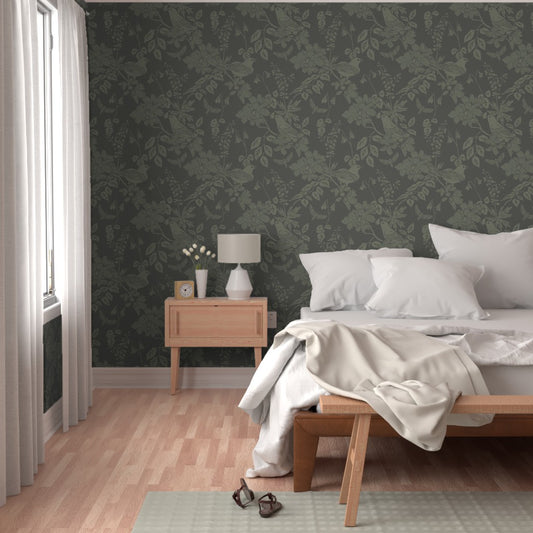
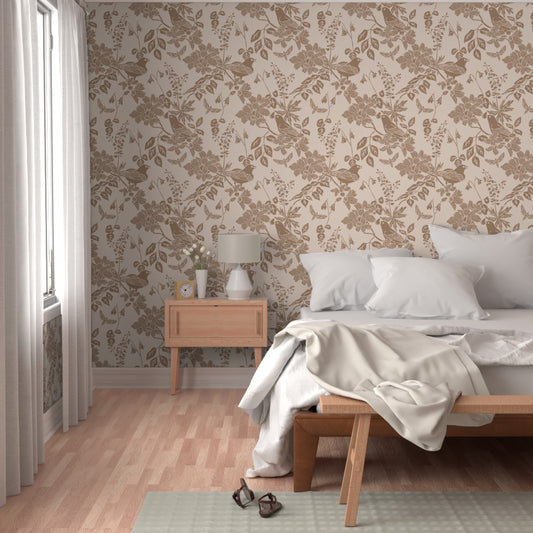
Colorway as mood-driver. The motifs do less work than most people think. The same species in a deep forest green reads moody and sophisticated. In creamy near-white it reads restrained and classical. In warm ochre it reads character and heritage. You are not locked into one feeling by the choice of vintage bird wallpaper -- the colorway steers the room far more than the bird does.
Scale. Vintage bird wallpaper in a small powder room creates the feeling of being inside a natural history illustration. In a larger space, the scale of the repeat matters more. Trust larger repeats more than you think you should -- they tend to resolve better at room scale than they look on a swatch.

A Love Letter to Home
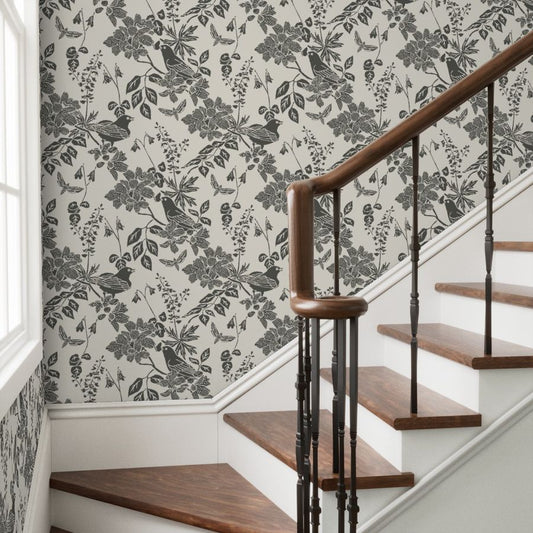
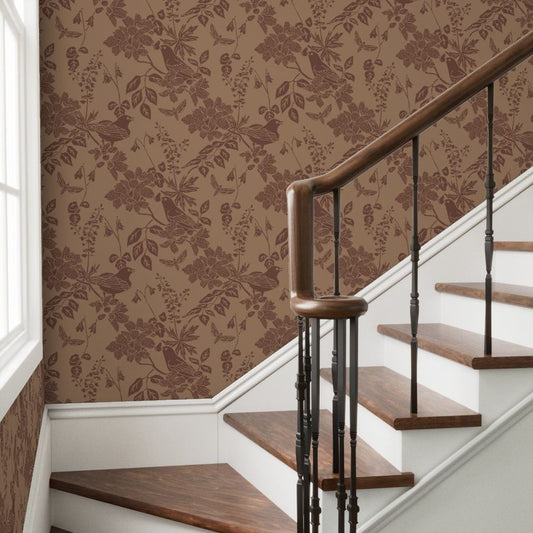
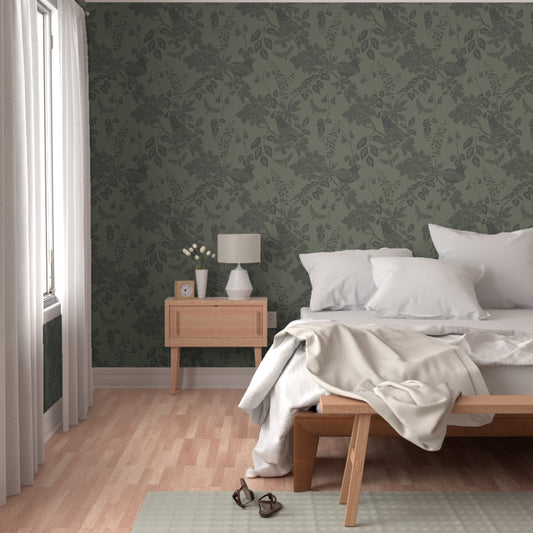
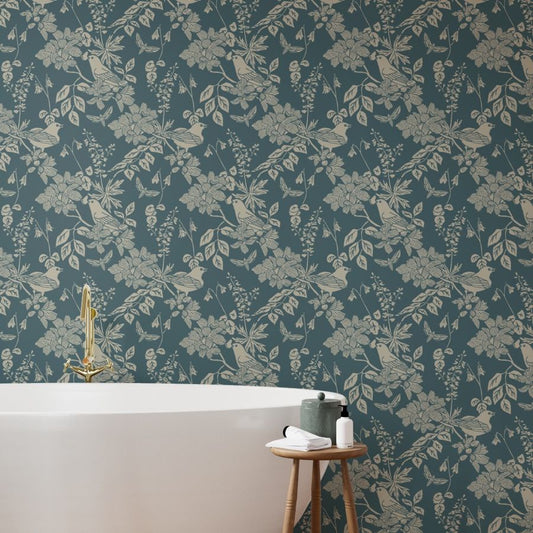
The Western Birds and Flowers collection is my attempt to do what Audubon did, at a smaller and more personal scale: document specific creatures from a specific place, rendered with enough care that someone who knows the landscape will recognize it.

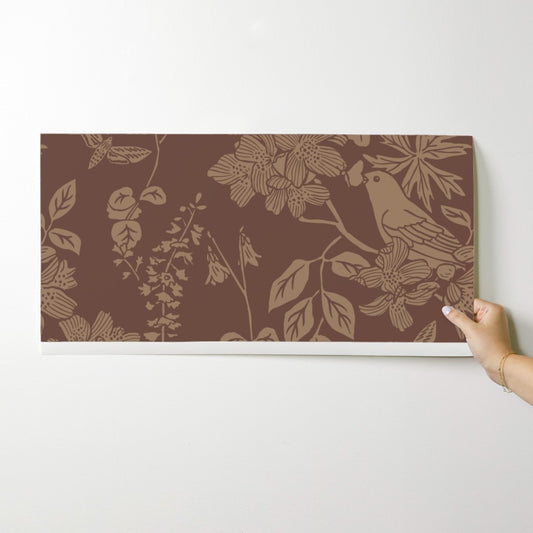
The collection is built around the mountain bluebird -- Idaho's state bird -- perched on syringa, Idaho's state flower. The supporting cast is all native Rocky Mountain Northwest: sphinx moths (the primary pollinator of syringa), twinflower, and lupine. These are the plants and creatures I grew up with in Montana and that still define the landscape I think of as home today.
I have loved mountain bluebirds since I was a kid. My dad and I built cedar nest boxes together and put them up in the yard, and every spring the bluebirds came back.
That specific shade of blue -- not navy, not sky blue, but something improbable and brilliant that stops you when you see it in a meadow -- is one of the things I associate most strongly with home. When I moved to Idaho, I found out the mountain bluebird is the state bird here too. The syringa, which blooms white and fragrant in early summer along the roadsides and hillsides of the Northwest, is the state flower.
It is not a pattern assembled from pretty bird references. It is a specific place, drawn by someone who grew up there.

Choosing Your Colorway
Every colorway in the Western Birds and Flowers collection is available in all four substrates: traditional paper, prepasted, peel and stick, and commercial vinyl for hospitality and contract applications. Swatches are available for all colorways -- worth ordering before you commit, since light conditions vary dramatically between spaces and what reads as sage green in one room can read as grey in another.
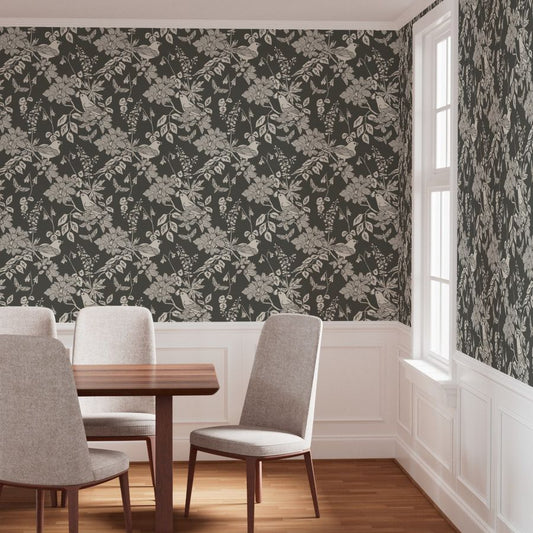
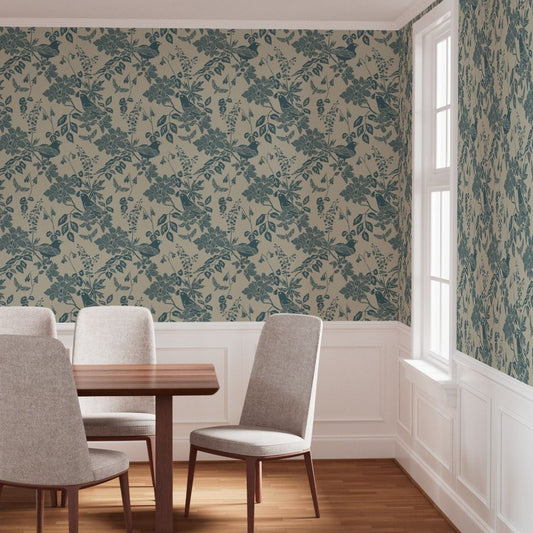
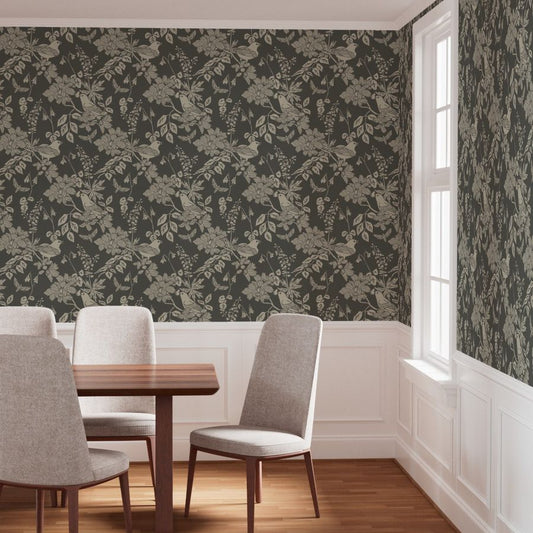
For dramatic, enveloping spaces: Forest Frost and Old Growth are the darkest grounds, where the botanical motifs seem to glow from the wall. Jewel Canyon brings the same presence in deep teal. Best for dining rooms, libraries, accent walls, and anywhere you want the room to feel intimate and considered.

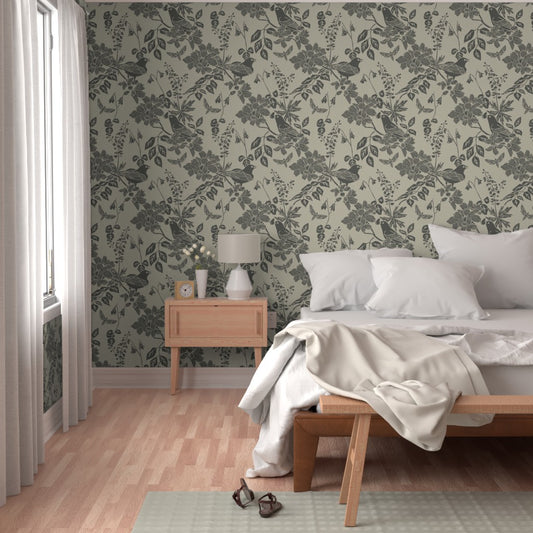
For calm, versatile spaces: Forest Rain (green-grey) and Sage Hollow (soft sage) read quietly in almost any room. These are the workhorses of the collection -- bedrooms, hallways, bathrooms, spaces where you want the pattern to settle in rather than announce itself.

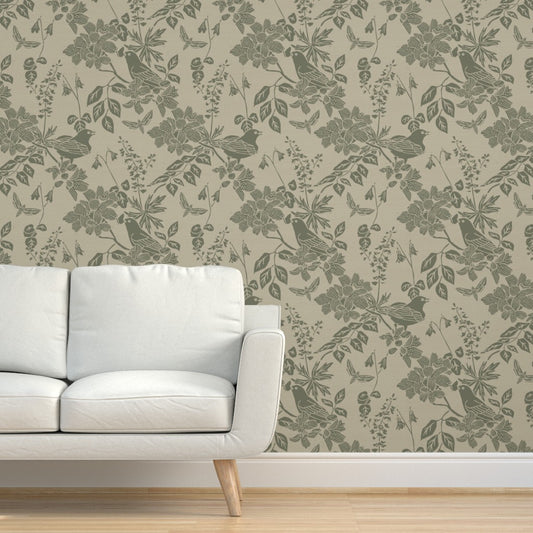
For warm, character-rich spaces: Buckskin (warm ochre and rust) and Saddle (rich leather brown) are made for lodge-adjacent interiors, heritage residential projects, and spaces that want warmth without heaviness. Both reward low, warm light.

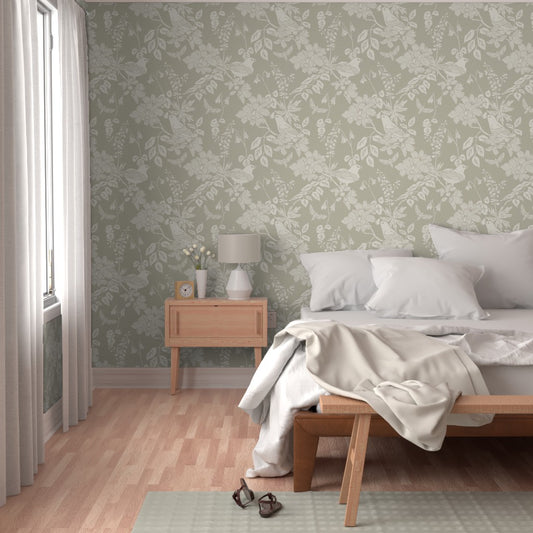
For gentle, restrained spaces: Prairie Rose (soft peachy blush), Pale Rain (creamy near-white), and Fern Mist (warm moss-green with gray-green undertones) are the lightest of the collection. Bedrooms, reading rooms, nurseries, any space that should feel unhurried.

For bold statements: Alpine Teal is the jewel-toned option for clients who want vintage bird wallpaper with genuine presence and confidence.

Bring It Home
The Western Birds and Flowers collection is available here, with swatches available for all colorways. If you are working on a project that calls for a custom colorway or a conversation about how the collection might fit a specific space, I am always glad to talk through it.
And if you are a fellow birder: yes, the Merlin app is still installed on my phone. Yes, I get unreasonably excited about new species. The Mountain Bluebird is in both the Wildcraft collection and this collection because I genuinely love that bird, and that is how every design decision in this studio gets made.